
Naval Air Defense Layers
Since we're talking about this at a national level.

Since the Constellation Cancellation and the advent of the U.S.S. Bullshit, we’re all talking about drones and Navy ship defenses. The vast majority of us don’t know much about this stuff at all, so I’m going to try to dispel a bit of the fog.
Attention Conservation Notice:
Nosy civilian who reads about acquisition stuff waxes poetic about Navy stuff he’s never actually seen. Will be better than National Interest fanboi stuff, probably not as good as TWZ. That being said …
Drones Defined:
People dismissively talk about hundred dollar drones taking out U.S. capital ships. That’s nonsense. We’re experiencing a bit of a “horseshoe” - China’s Dongfeng DF-21 flies itself, it’s an autonomous drone, but one that delivers a half ton of explosives by coming straight down five times faster than an F-35 can fly.
Any talk of drones should involve a qualification on what the drone actually is, and how it differs from a cruise missile. We’ll use the following definitions for these two objects for the sake of understanding scale.
A drone is a $100,000 dollar object a hundred miles offshore, moving at a hundred miles an hour, and packing a hundred pounds of explosives.
A cruise missile is a $1,000,000 object that might be found as much as a thousand miles offshore, moving nearly a thousand kilometers per hour, and packing a thousand pounds of explosives.
As real world examples, a Shahed 136 costs $193,000 and packs 110 pounds of explosives moving at 115 mph. An AGM-158C LRASM is a $3 million cruise missile with a thousand pound warhead that has a range of 500 nautical miles.
Drone Doctrine:
Drones are slow, propeller driven things that are not very smart, at least for the moment, and while dangerous, they do NOT deliver knockout punch sized blows, at least to navy ships built to take hits. Commercial ships are not built to that standard and a hundred pounder against a tanker may well be the end of it. Cruise missiles are autonomous, maneuvering transonic jets with stealth features and a single hit on a modern navy ship is intended to prove deadly.
Drones are a collage of accessible technologies that are now evolving rapidly thanks to the Russian invasion of Ukraine. Their costs are decreasing, while their capabilities are increasing, and their mantra is “strength in numbers”. If you fire a million dollars worth of the drone, as defined above, a U.S. destroyer will expend $21 million worth of the older SM-2 or $43 million worth of SM-6 to stop them. A sneaky cruise missile might not get intercepted until its right on top of them, at an intercept cost of the cost of a single $1m Rolling Frame missile.
So drones are a numbers game, both at the acquisition level, where they have a tremendous cost advantage, and in deployment, where they can flood defenses.
Defensive Layers:
U.S. Navy ships have five layers of defenses against things that fly at them. The first three layers are all delivered via the Vertical Launch System, with the Mark 41 8 cell launcher being most common. Most Arleigh Burke destroyers have 96 total cells, the older Ticonderoga class cruisers have 122.
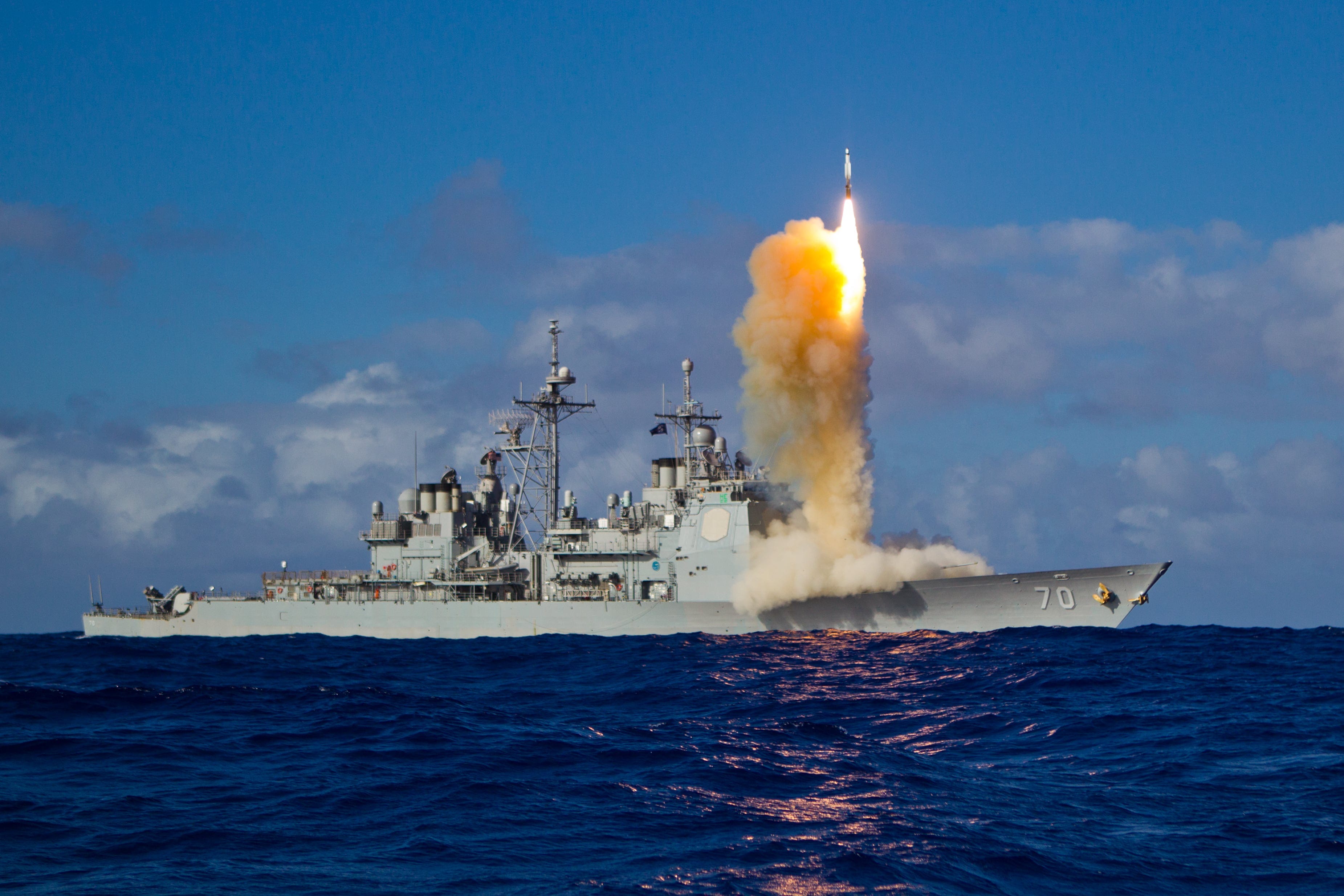
The RIM-161 Standard Missile 3 is a ballistic missile intercepter - costs a small fortune, hits things coming down at you very fast, or even satellites in low Earth orbit.
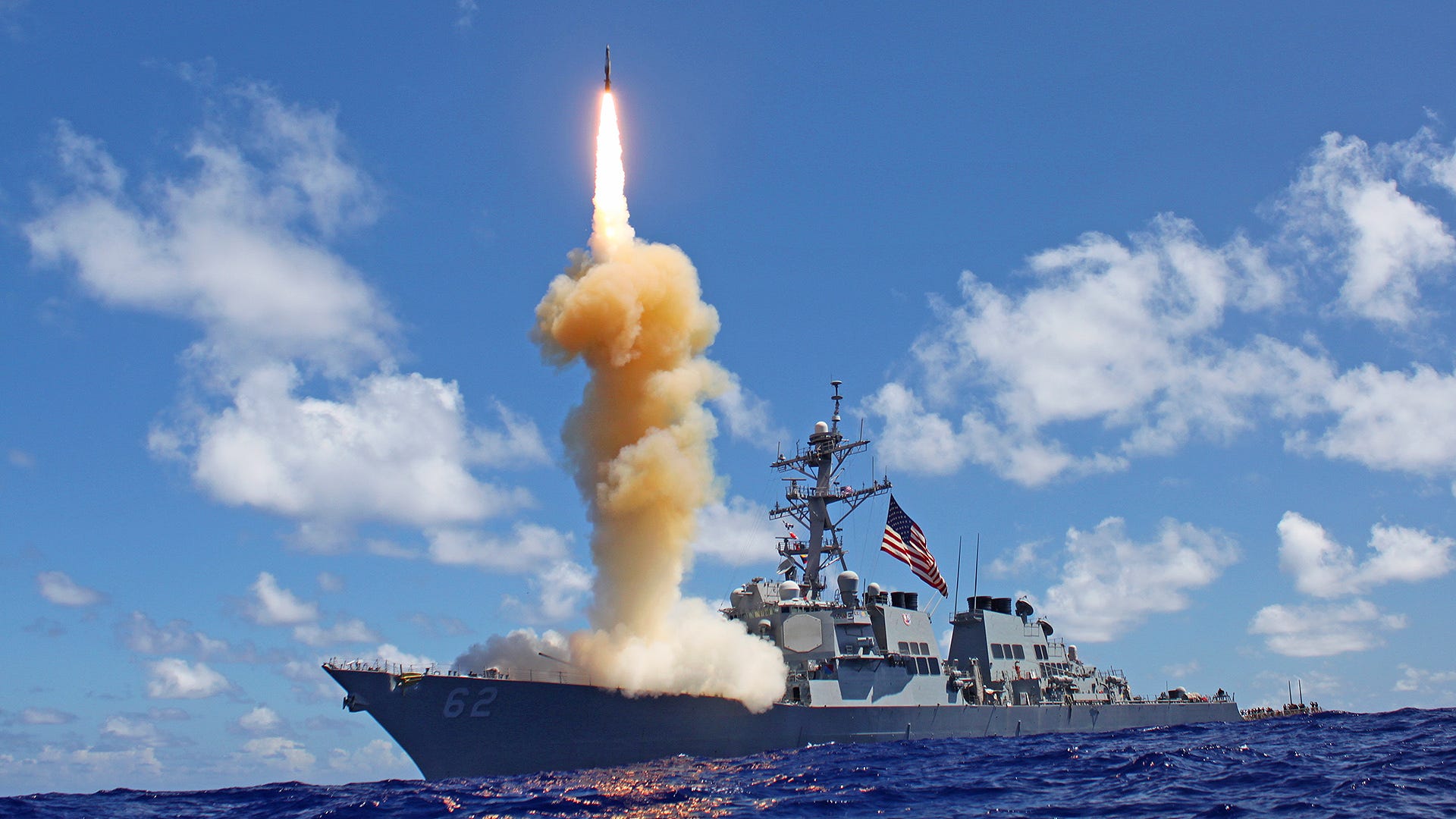
The older RIM-66 Standard Missiles, the longer range RIM-67 versions, and the current RIM-174 ERAM aka Standard Missile 6 provide a bubble around U.S. Navy carrier/expeditionary strike groups for at least a hundred nautical miles, at a cost of a couple million each.
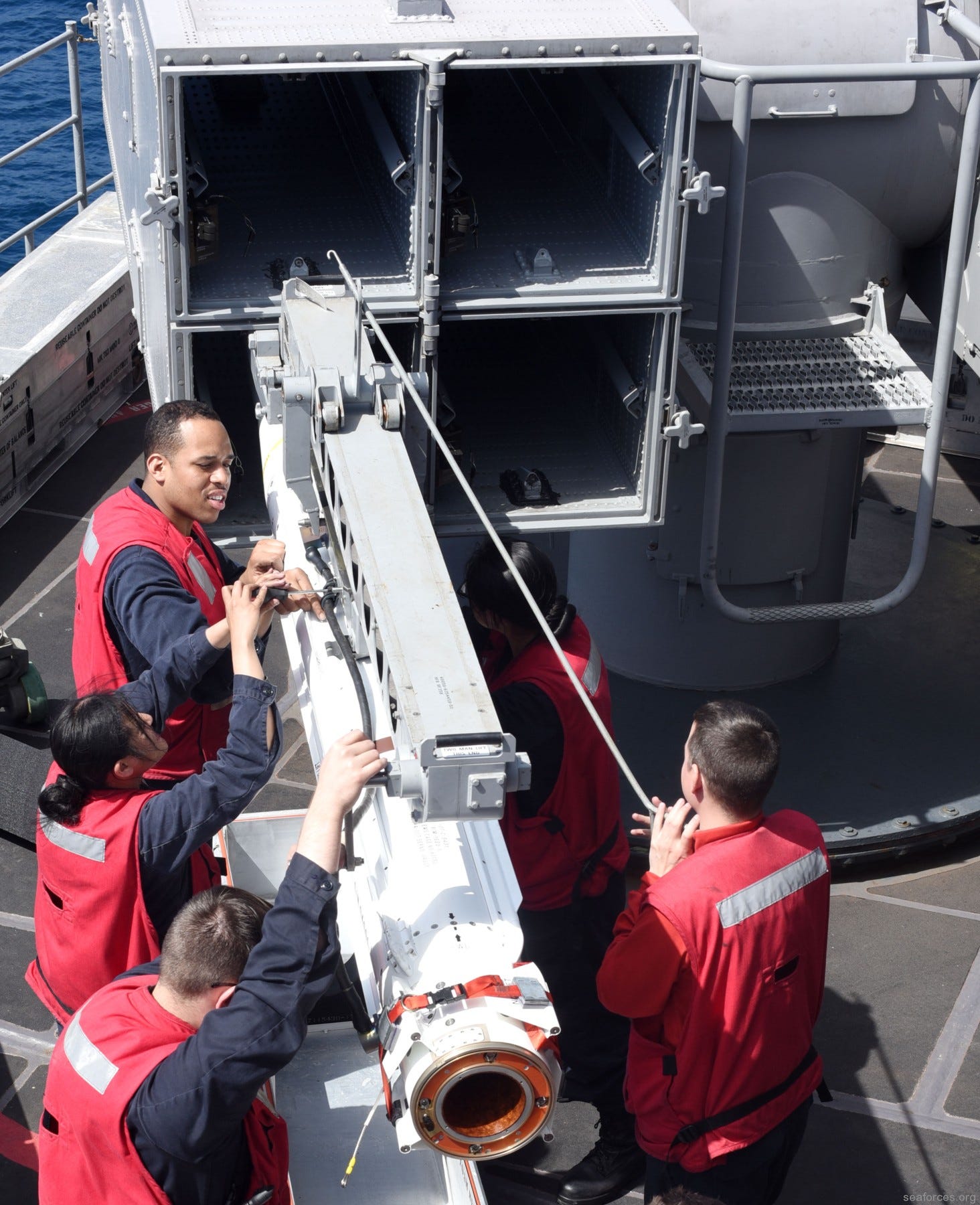
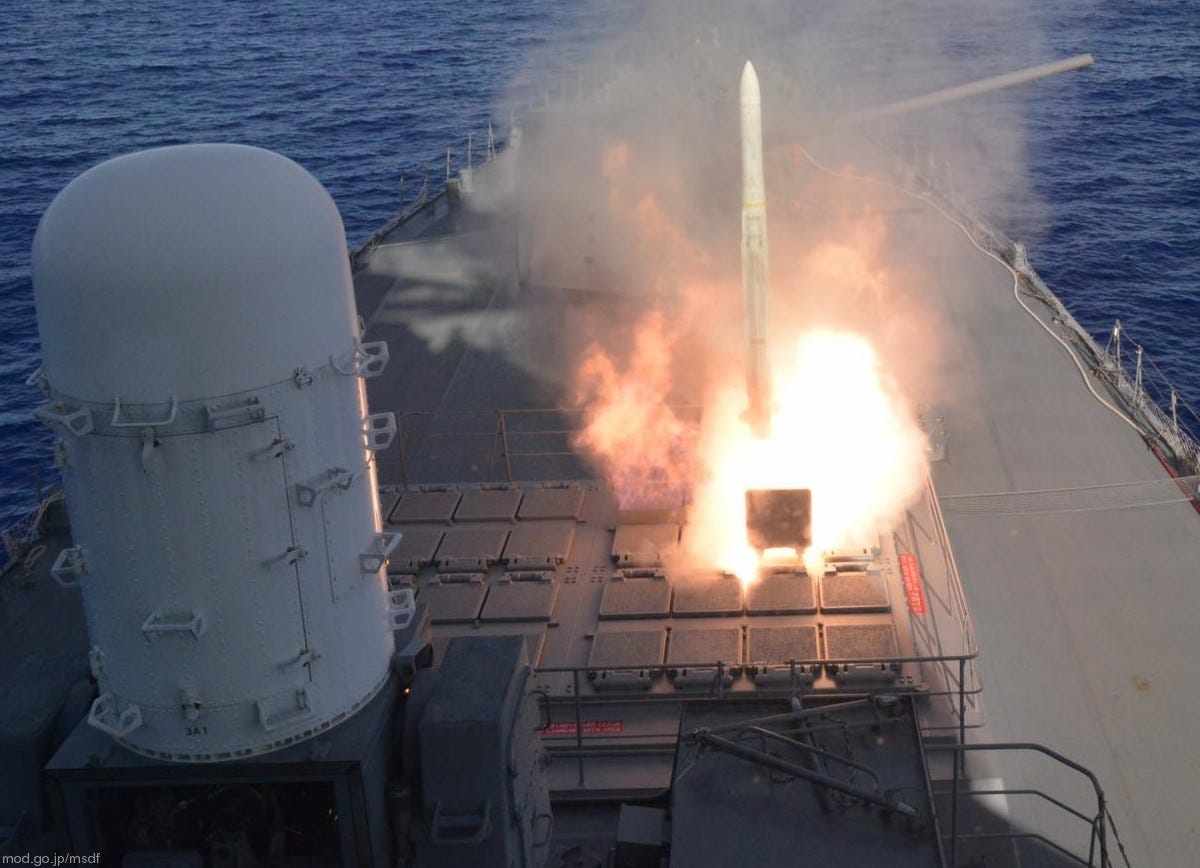
The RIM-162 ESSM is a smaller missile that comes in a four pack for VLS cells. This million dollar device, derived from the AIM-120 missile fighters carry, puts a twenty seven nautical mile bubble around ships.
The RIM-116 Rolling Frame missiles are tiny, fast, million dollar devices available in 21 shot deck level dispensers. They have a five nautical mile range.
The Phalanx CIWS is an independent radar system with a 20mm Gatling gun is a last mile option that responds automatically to anything that gets past the Rolling Frames.
The cruisers and destroyers originally had the VLS cells and Phalanx CIWS. Their job is to keep trouble at bay. The Rolling Frame is found on many other types, including aircraft carriers, where it’s meant to head off stuff the cruisers/destroyers miss. Newer Arleigh Burke class are losing the poorly regarded CIWS in favor of the SeaRAM, which combines the Phalanx radar with an eleven shot Rolling Frame missile launcher. The smaller size is specifically due to the Phalanx mounts - the eleven shot weighs the same as the Gatling gun its replacing.
It should be mentioned that there ARE laser weapons, but only one AN/SEQ-3 was deployed, and there are only a few HELIOS in testing. This is something that IS coming, something that the experiences in Ukraine have made urgent, but it’s not a thing yet. Even when it IS a thing, rain happens, there are divergent opinions on how important a clear weather only defense is.
Unstructured Musings:
The U.S. Navy thwarted Houthi attacks on shipping in the Red Sea, winning every battle by exchanging a $4m interceptor for a $200k drone. Things settled down due to a variety of factors, but this is clearly unsustainable. Even without the budget hit, most of these expensive gadgets are built at the rate of a few a month. We got used to not fighting during the Cold War and its messy insurgent aftermath. That honeymoon is well and truly over.
The DF-21 exists to force U.S. carriers to stand back far enough that their fighters are ineffective. China secretively tests against mocked up ships in the middle of the desert, we periodically shoot ballistic missiles in carefully choreographed “tests” that get mocked for lacking real world factors. The SM in SM-3 appears to stand for “Sorta … Maybe”. Nobody can predict what will happen here, eventually we’re going to be forced into trying it live.
We discarded the notion of gun based ground defense against air threats after the failure of the M247 Sergeant York during the late Cold War. Every single thing we’ve ever built for this role has ended up relegated to infantry support. They are however making a comeback in Ukraine, most noticeably Germany’s Gephardt, which quickly and cheaply dispatches Shahed drones. I’ve not seen any reporting on how they do against cruise missiles, but they were built to hit close air support jets, so I assume they’ve had at least some success. The naval equivalent of this is the Mk. 110 57mm - has enough reach to get to flying things and enough punch to do something about it.
Another thing that is not so much coming back as it is evolving are the venerable 70mm unguided rockets. There are 70mm guided solutions in use in Ukraine. This is obviously not appropriate for naval use, but we need thinking like this. Something that costs like a Shahed ($200k) but that hunts like a Rolling Frame ($1m), but at much longer range and lower speed? A Rolling Frame launched 250 knot device with long, slender pop out wings that can reach out a hundred nautical miles?
Cruisers and destroyers typically have MH-60 Seahawk but they also occasionally pack MQ-8 Fire Scout drone helicopters. The Seahawk might be found carrying lightweight torpedos for anti-submarine duty. The MQ-8 is too slow, the MH-60 is marginally capable of running down drones, and there are existing mounts for 70mm rocket dispensers. Doesn’t exist yet, but anti-drone helicopters are absolutely going to be a thing.
The MH-75 won’t work on surface combatant landing pads, but the SB-1 Defiant would. This dual rotor coaxial helicopter with pusher prop looks like a genius move to me, but it’s got Boeing in it, and I have learned to respect their ability to aim for their toes and take off a leg at the hip.
Visuals:
SM-3 launching from USS Hopper DDG-70
SM-6 launch from USS Fitzgerald DDG-62
TIL the RIM-162 ESSM also comes in a four shot deck mount in addition to VLS. These go on the same ships that have the Rolling Frame.
This is an ESSM launching from a Mk-41 VLS cell on a Japanese ship.
USS Green Bay LPD-20 firing a Rolling Frame from a 21 shot deck mount.
Sea-RAM 11 shot on an unnamed Arleigh-Burke firing a Rolling Frame.
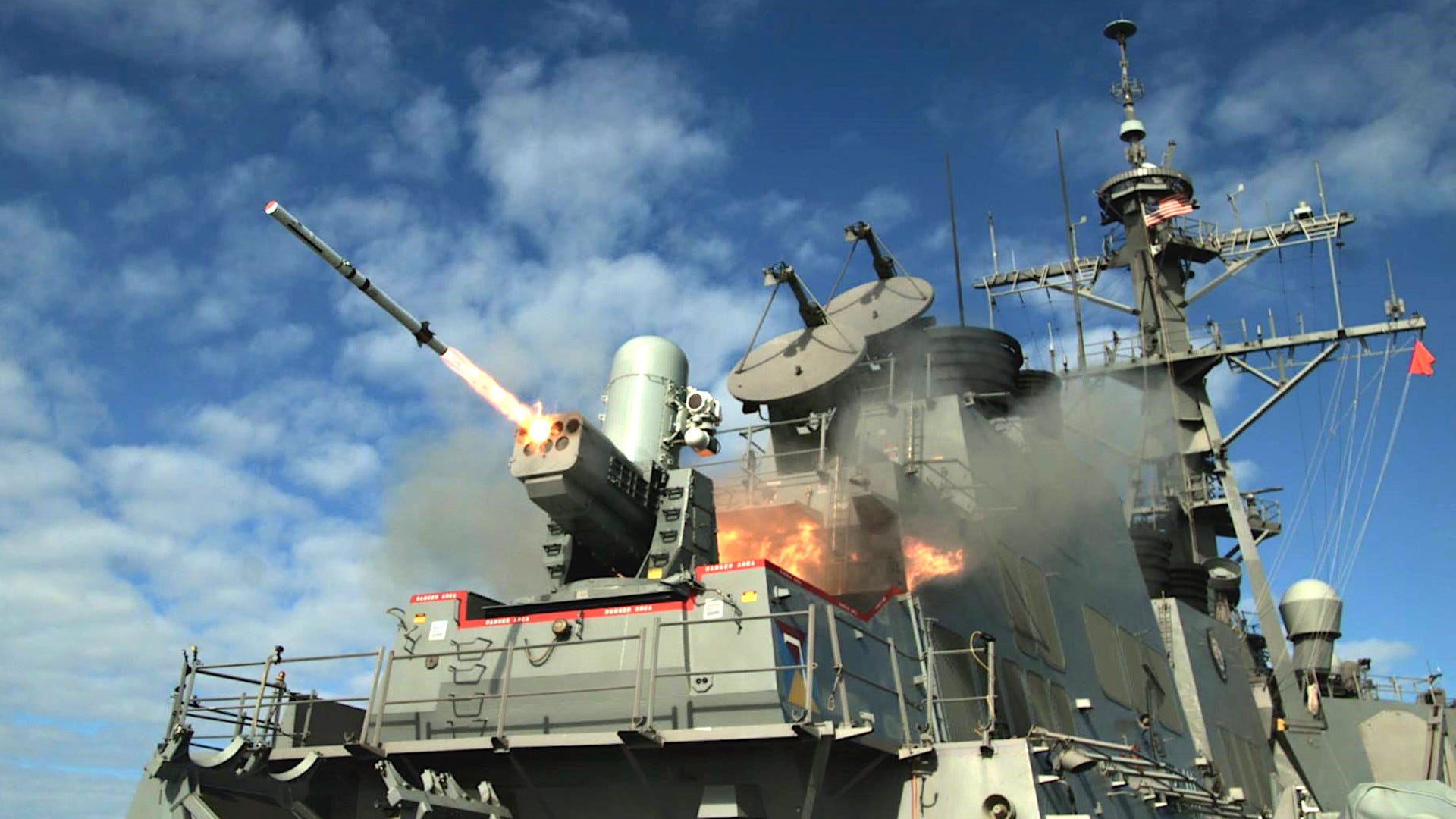
Phalanx CIWS cutting loose with a LOONNGGGGG burst.
Land use of Centurion C-RAM Phalanx at night - just so you can see the 20mm self destruct at the end of their run. The Navy rounds do NOT self destruct, they’re tungsten penetrators.