PS: Hot Pursuit
Of paying customers ...

We’ve had some ups and downs on our way to funding. As an example of what that looks like, among four cofounders, two concussions so far this year. And now there’s a person I know with a broken ankle and the urge to do some market research for their startup. We call this synergy.
I’m setting up some tooling to support hunting up potential paying customers and tracking interactions with them. I think there will be some insight to be had in this, as in one case it’s a company that’s ready to go to market, in the other it’s a founder who is just starting in a certain area.
Come on in and I’ll explain what I’m doing and why …
The health care startup, which has gone through a couple rounds of “we need a new name”, has two problems. The first is getting to the masses who have intractable health problems, and the second is finding and approaching their care providers. This other thing is similar in that it needs to gather information on licensed professionals who keep a public office, similar to the manner in which independent doctors do.
I have evaluated and tossed quite a few tools. The ones that stuck in this area include:
Claude Cowork - now it has all the automation you can get with OpenClaw, and none of the security grief.
Exa - this search utility offers an MCP server and it can do LinkedIn specific queries. Not all of the people we seek will keep a presence there, but it is common enough that it’s worth checking.
Perplexity - we’re paying for Pro level service to get the web interface search functions and we might get a single seat of the $200/month Max at some point.
Hubspot is a well regarded customer relations management (CRM) tool and they offer two seats for free, which fits both efforts.
What about all the things that I tried and abandoned? Staying on top of things in this market is like setting sail on an iceberg. Every once in a while the whole thing just rolls, and you’ve got to scramble to stay out of the water. What I am seeing with tools now is a tremendous time compression. Formerly, if you had a product with a similar price and a couple nice enhancements the market leader did not include, you could start carving out a niche. Now, thanks to the functionally instant shipping of new features, those attempted market penetrations are a LOT harder. It’s easy to make an innovation, but well nigh impossible to keep one.
Discards:
The debris field of discards over the last eight months includes no fewer than four team storage environments.
We have Google Workspace but it kinda sucks for all the tools I want to use.
We set up Jira, but getting people to move was … problematic, and things were not stable.
We set up Wekan, avoiding cost, and we neatly avoided internal uptake, too.
We got on the 90 day Notion promotion, and it works tolerably well, once you master the authentication shenanigans that come when you’ve got a personal and professional account on the same client.
So the most familiar, least capable incumbent remains incumbent, and the evals result in me doing a lot of setup work, and there’s just not enough activity to justify their continuation. So the solution to this conundrum is …
Trying Claude Teams. We need more AI capability and we’re getting three Max level accounts and two Pro. The thing you get with Teams is shared storage of Projects, which is NOT as capable as Notion, but if it’s attached to a thing we MUST use, and we’re paying for that thing, I think it’ll finally stick.
Wisdom: These tools I describe up above are decent. So are other market leaders. Some of the innovators may survive but I’m not sure they can thrive; it’s too easy to make off with the things that make them interesting in the first place. There ARE other tools that meet this criteria and if you or your team are familiar with one, assess how they’re doing in a world going AI. Microslop is foundering; big ships turn slowly. The smaller companies may have had false starts, but they WLL figure it out.
Change is a form of production, and as Nate B. Jones is fond of saying, “production is free, the taste to know what’s good is not”. You’re going to need to develop a sense of what is and is not possible in this world, both for your team, and the vendors you use.
Market Forces:
Two out of every three planned AI data centers seem like they will not be built: political resistance from communities, the helium hit on chip production due to the Netanyahu/Trump (mis)adventure in Iran, the fact that power switching equipment lead times were up to five years, before a massive disruption in Asian economies due to the end of Persian Gulf natural gas flow.
Even with the data center blockade, memory and storage prices are crazy. The GPU I got for $419 last fall now sells for around $700. The Nvidia RTX 5090s we offered to people who are doing certain contract jobs with the startup were under $3,000 when we made the agreements, and now they running $5,500.
Google’s TurboQuant algorithm promises a four to sixfold reduction in KV cache memory required to run models without any reduction in their capability. This effect requires some pencil and paper math to figure out what it means on a GPU that you own, but for the hyperscalars it could mean a 400% boost in concurrent capacity just by changing code. This would take some of the heat off the datacenter construction push, if it works in production. Big IF.
BonSai is now showing one bit LLMs that are performing as well as their sixteen bit counterparts(!) I don’t understand how this is possible, but you CAN download working examples. If this sticks we’ll see personal computing going wild with it. This means a 2GB Raspberry Pi may perform as well as my 16GB MacBook Pro. Next generation chips will include one bit instructions in their existing vector processing functions, which will yield astonishing on device capability. We’ll still need GPUs, but CPUs will be far more capable than they are today.
I know you want a nice “and this is what it all means”, but I’m not going to hazard a guess, not with a disastrous war in effect and a spectacular run of technological advances driving massive social change. Notice that things involving atoms are increasingly difficult, while things involving bits just keep getting easier.
I’m hoping the aforementioned combination of hard to buy/build, and whopper performance improvements using code that runs on existing hardware are going to balance each other, at least at the scale where I work.
A few final capacity/money related thoughts. Anthropic et. al. are massively subsidizing those of us using their service. I get Claude Max for $100/month. When I hit my limit, my little overflow fund drains at the rate of about $20/hour. I saw that I had used 400 hours of Claude Code(!) in the last 28 days, so the real world cost would seem to be around $50k/year per the two FTE equivalents I get out of that plan. These subsidies WILL end and that might come in a precipitous fashion given the world’s volatility. Are you ready to pay what the tokens you are using actually cost?
And an addendum to that. I spent an hour using a 24GB Nvidia RTX 4090 via an ssh tunnel last week, and I promptly put my 16GB RTX 5060Ti up for sale. Running a GLM model that required 19GB on disk was so dramatically different from anything I could do with the 16GB card, there’s just no point in hoarding a device that’s half of what I need. Assuming TurboQuant is smoothly integrated into tools like Ollama and vLLM, KV cache can be a fraction of its current size. A 32GB RTX 5090 will perform like a 48GB RTX 6000 Pro does today. This is a personal frontier for me - that’s enough of a card to do a lot of things I’m currently using Claude to do, and it’ll be nice having compute that does not have an enormous price tag attached to it.
Tooling Itself:
Now that we’ve got that 1,400 word preamble out of the way, let’s talk about actually wiring some stuff up for business.
The minimum cost for Claude Team is five Pro accounts at $25/month each - $125 total. If you’ve got one person that’s really slick with AI, get them the $125/month Max, and your other four team members cost you $100/month total. So that’s $225 to have a well enabled group.
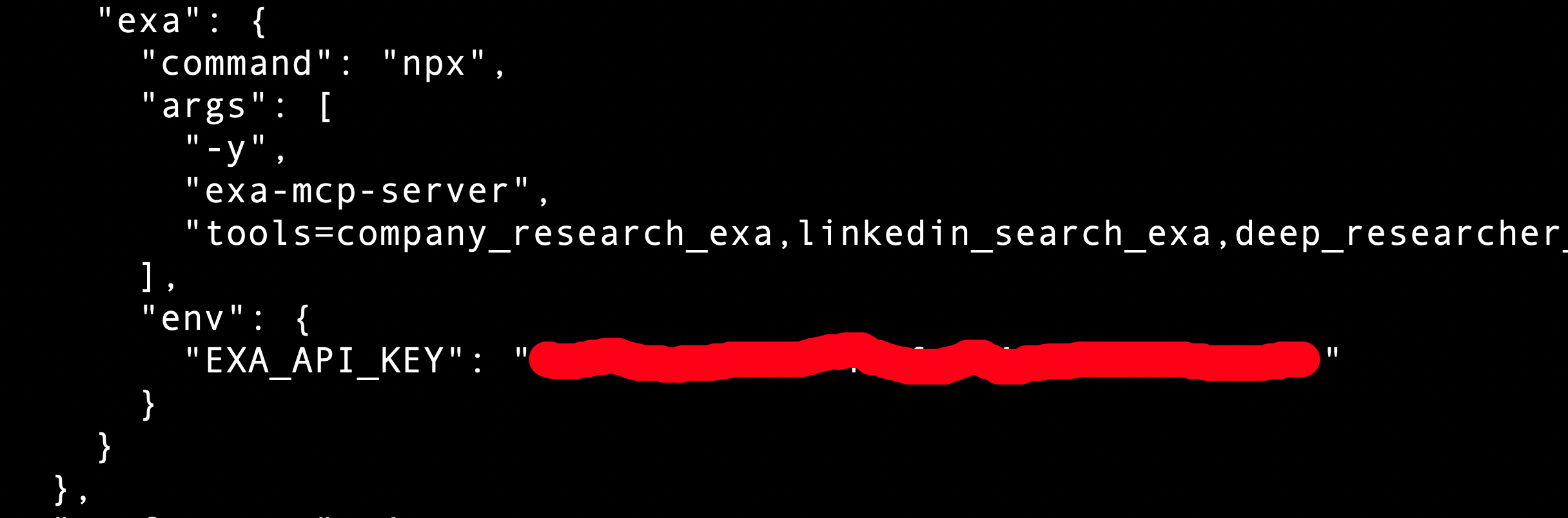
You can use Exa from its web interface, but it’s served me better when it’s an MCP server that Cowork can use as part of its overall research process. You might have to open a text editor and touch a scary file that looks like this, but I am sure you can do it; Exa offers excellent documentation.
Perplexity has always been better as a web interface than an MCP call in my experience, at least at the level of the gratis Pro account I’m running. This is no longer available as MCP, even if you paid for the $20/month Pro level service. I think Perplexity’s progression is a sign of what’s to come - the minimums are going to be $100 - $200/month for any sort of usable service. So if you didn’t get your gratis Pro last fall, shell out $20 to see how this works for you.
Hubspot - there are a LOT of CRM systems out there and thanks to AI enabled acceleration many of them have excellent feature sets. This one was chosen by someone I work with based on their prior experience and it’s been fine. Thanks to Claude it was really easy to get a web enabled leads form running using a Cloudflare Worker, as opposed to exposing the site with some vibe coded thing I can’t properly secure.
To Be Continued:
This was written right around the start of April, now it’s the end of the month, and we’ve added a back injury to a cofounder, as well as two funerals this week for parents among our close circle of associates. I know 2026 is a global exercise in peak stupidity, but this .. pelting … can end any ol’ time.
This got really long before I even got to the Claude Teams setup, and I’m not even into that yet, because other things got in the way.
Now you know what I’m doing, the next time I write it’ll be about what we get out of having Claude Teams. I think we’ll be doing it at the $125 for five seats level, it’s just not clear to me that the compute value is gonna hold, and the founder of that other company prefers to minimize costs.
So until next week … ttfn.